The Sending
Sophia’s thirteen repentances had risen out of the dark like threads of smoke, and the Fullness had received every one. The question the Pleroma faced was not whether to answer, the Light does not ration itself, but how. A voice had already been sent, once, to correct the blind god; the voice had been heard and defied. Something more than a voice was required. The Ineffable resolved to send a person.
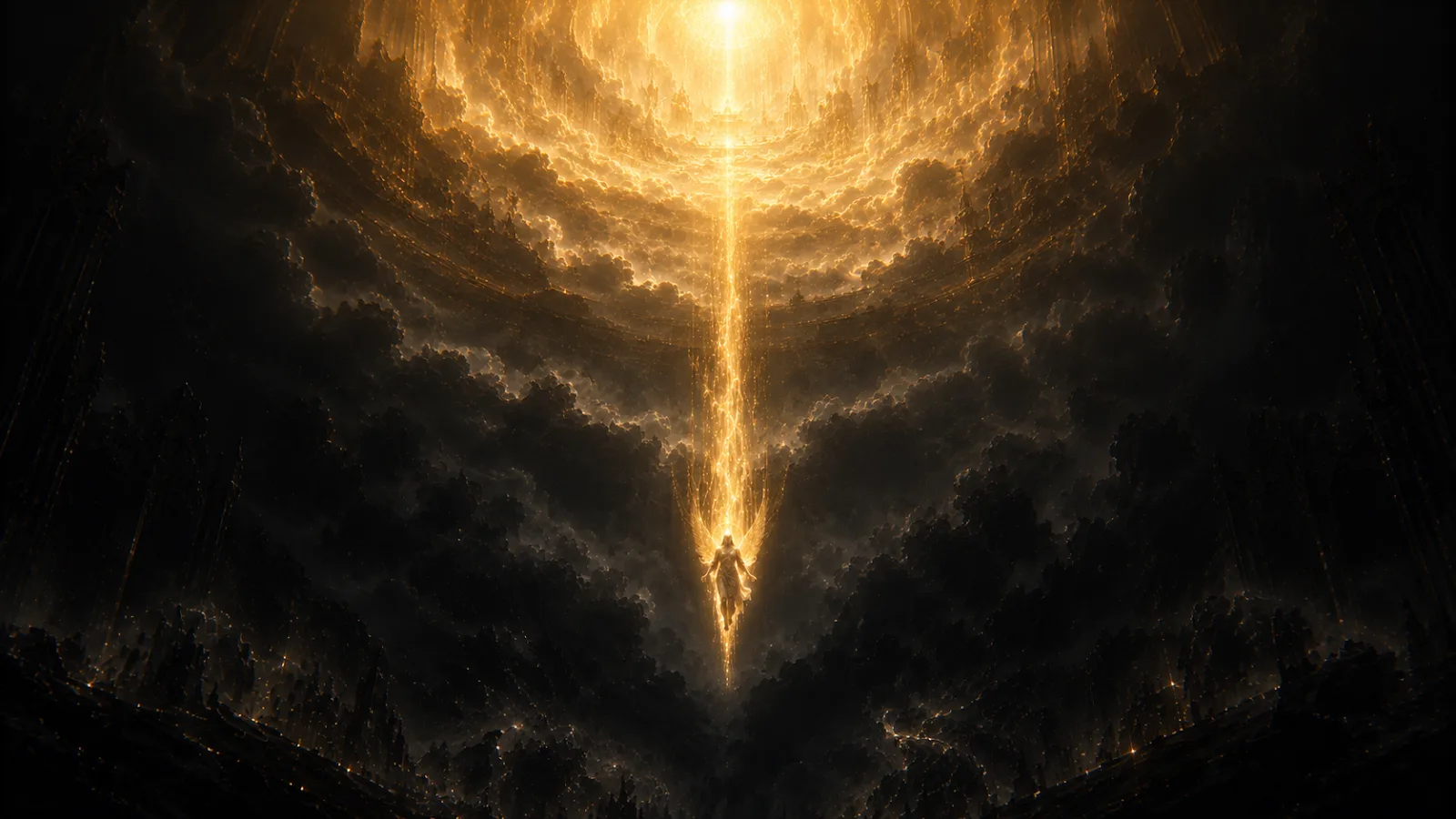
The Aeons together brought forth their common fruit, the texts call him by many titles: the Savior, the Christ, the joint flower of the whole Fullness, and equipped him for a journey no light had ever made: down. Out of the Pleroma, past the Boundary, through the Thirteenth Aeon where Sophia’s empty house stood dark, and into the stacked heavens of the enemy.
A radiant male figure of golden light standing at the very rim of the Pleroma — an infinite realm of living white-gold radiance behind him — looking down over the edge into a stacked abyss of thirteen darkening heavens, each level dimmer and colder than the last, vanishing into black. His wings of light furl tight against his back like a diver’s arms; the light of home streams past him into the deep and dies a few fathoms down. The last calm moment before the descent. Extreme vertical composition, epic scale, gold against fathomless blue-black. Blizzard cinematic concept art, photorealistic CGI render, volumetric god-rays, breathtaking.
“And the whole Pleroma consented, and set its seal on him, and he went out from the Light singing.
The Garments of the Heavens
Here the story produces its most beautiful invention, the one detail every Gnostic school retells. The Savior did not descend as a blaze of glory, parting the heavens like a spear. He descended as a secret. At the border of each heaven he put on the form of its inhabitants, the likeness of its angels, the dress of its powers, so that in every realm he passed, the wardens took him for one of their own.
“In every heaven I took their form, that they might not know me; for had they known me, they would not have let the Lord of glory pass.
A cloaked figure passes through a colossal dark gate between two heavens, wearing the grey angular likeness of the realm’s own angels like borrowed armor. Towering warden powers flank the gate with spears of cold fire, their blind gazes sliding straight past him. The disguise is perfect except for one detail the viewer alone can see: a hairline seam of pure gold light glowing at the edges of the borrowed form, like sunlight under a door. Stealth at cosmic scale, tension in stillness, cold monumental architecture. Blizzard cinematic concept art, Diablo IV gate-of-hell grandeur, photorealistic CGI render, immense scale.
There is a whole theology folded into the trick. The light does not defeat the dark by outshining it first; it defeats it by entering it completely, by being mistaken for it, by going where the dark is sure nothing bright would ever consent to go. The descent through the heavens and the birth in a stable are, in this telling, the same maneuver at different altitudes.
The Lion at the Twelfth Gate
One power was not deceived, or was too afraid to care whether it was. At the Twelfth Aeon, his own dominion, the cold heaven from which the whole disaster had been engineered, Authades the Self-Willed felt the passage of something that moved like his old enemy’s light, and loosed against it the same weapon that had devoured Sophia: the lion-faced power, the emanation of his envy.
The moment of unmasking: a radiant figure erupts out of his borrowed dark form — the disguise shattering off him in fragments like broken obsidian — into full golden glory, wings of light snapping open. Facing him across a cold silver heaven rears a colossal lion-faced power of shadow and hunger, all mane and void and teeth, big as a citadel. Between them the air itself burns where light and devourer meet. Opposing warm gold and dead silver-black palettes colliding at the center of frame, shockwave light, debris of shadow. Blizzard cinematic concept art, Warcraft-cinematic boss confrontation, photorealistic CGI render, apocalyptic scale.
And here, for the first time since leaving the Fullness, the Savior stopped hiding. The borrowed garment fell away, and the light that the lion had once fed on stood before it undiminished, and the devourer learned the difference between fallen light and light at the source. The texts spend no sentimentality on the fight. He trod down the lion-faced power; he took from Authades the strength that had made him dangerous; and he left the Self-Willed on his throne, dimmed, disarmed, and alive, to watch what his one act of envy had summoned up the well of the worlds.
“I took from him a third of his power, that he might no more devour the light of them that repent.
Through the Kingdom of the Blind
Below the twelve heavens lay Chaos, and into Chaos he came with nothing hidden at all. The kingdom of Yaldabaoth had never seen unstolen light. Its wardens had spent eternity guarding against an escape from below; nothing in their watch had prepared them for an entry from above.
A blazing figure of golden light descends into Chaos itself — a black seething realm of storm-matter and drowned architecture — like a comet entering deep water. Dark archon hosts recoil and scatter from him in every direction like startled birds, their formations shredding. From the farthest corners of the dark, thin threads of trapped golden light tear loose and begin streaming toward him, bending around obstacles, answering their source. His radiance carves a sphere of day out of a kingdom of night. High-energy, kinetic, awe-inducing. Blizzard cinematic concept art, StarCraft-cinematic spectacle, photorealistic CGI render, volumetric light, immense scale.
He moved through the dark kingdom like a magnet through filings. Every fragment of Sophia’s scattered radiance, hoarded in the treasuries of the Archons, worn as trophies, mortared into the walls of the seven heavens, tore loose and streamed to his hand. The wardens who tried to hold their plunder found they were holding fire. The blind god on his throne felt his kingdom growing dimmer room by room and could not see why, which is the one sentence that contains his entire biography.
The great reclamation: rivers of golden light streaming from every corner of a dark cosmos — out of treasuries, out of towers, out of the very mortar of seven dim heavens — converging in luminous currents toward the open outstretched hand of a radiant figure at the center of the frame. Dark powers scatter along the light’s path, some still clutching fragments that burn their hands as the radiance tears free. The composition a vast inward spiral of gold against blue-black ruin. Triumphant, inexorable, beautiful. Blizzard cinematic concept art, photorealistic CGI render, volumetric streams of light, cosmic scale.
The Finding
And at the bottom of everything, below the last heaven, in the dark below the dark, he found her: the ember that had cried out thirteen times, so nearly extinguished that the darkness itself had stopped guarding it. The epic pauses here, and so should we. All the strategy of the descent, the garments and the gates and the broken lion, all of it existed for this one bending-down.
In absolute darkness at the bottom of everything, a vast radiant figure kneels — wings of light folded, head bowed — toward a tiny guttering golden ember resting on black nothing, and inside the ember, barely visible, a curled feminine form no larger than his fingertip. His hand reaches toward it, not touching yet: one point of imminent contact at the center of a frame that is otherwise pure void. His light falls on her like the first dawn on the last coal. Tenderness at cosmic scale, extreme contrast of size and brightness, sacred hush. Blizzard cinematic concept art, photorealistic CGI render, chiaroscuro, devastatingly intimate.
Thread by thread he gave the gathered light back, and added to it light of his own, so that she rose brighter than she had fallen. That arithmetic, restored greater than before the loss, is the Gnostic signature on the whole story. The Fullness does not merely repair. Then he set her on the road upward, through heavens that could no longer stop her, toward the Thirteenth Aeon and the Boundary and home.
“I found her, and she was become as a light that is at the point to go out; and I made her a crown of my own light.
The Road Left Open
A lesser story would end with the gates repaired behind them. This one ends with the gates broken on purpose. The way the Savior opened, down through the heavens unrecognized, up through them irresistible, did not close after Sophia passed. It is, the Gnostics taught, still there: a road through the kingdom of the blind god, running from the bottom of matter to the door of the Fullness, waiting for every spark that wakes.
The Savior and a restored radiant feminine figure ascend side by side through torn, broken dark heavens — gates hanging shattered off their hinges, warden towers dark and abandoned — toward an immense golden light blazing at the top of the frame. Behind and below them, the path they came by does not close: a permanent corridor of warm light running down through every ruined level to the bottom of the world, lit like a road at evening. Wind of ascent in her hair and robes, his hand steadying her. Hope at cosmic scale, vertical composition, gold burning through blue-black ruin. Blizzard cinematic concept art, Warcraft-cinematic finale, photorealistic CGI render, immense scale.
That is why this epic mattered enough to hide in jars in the Egyptian desert. Not because it recounts a rescue that happened once, somewhere above the sky, but because of what it claims is true now: the wardens are stripped, the lion is broken, the toll-gates stand open, and the same road runs through you. The descent was history, the Gnostics said. The ascent is biography. Yours.
“I am the way down and the way up: the descent no warden knew, the ascent no warden can refuse.