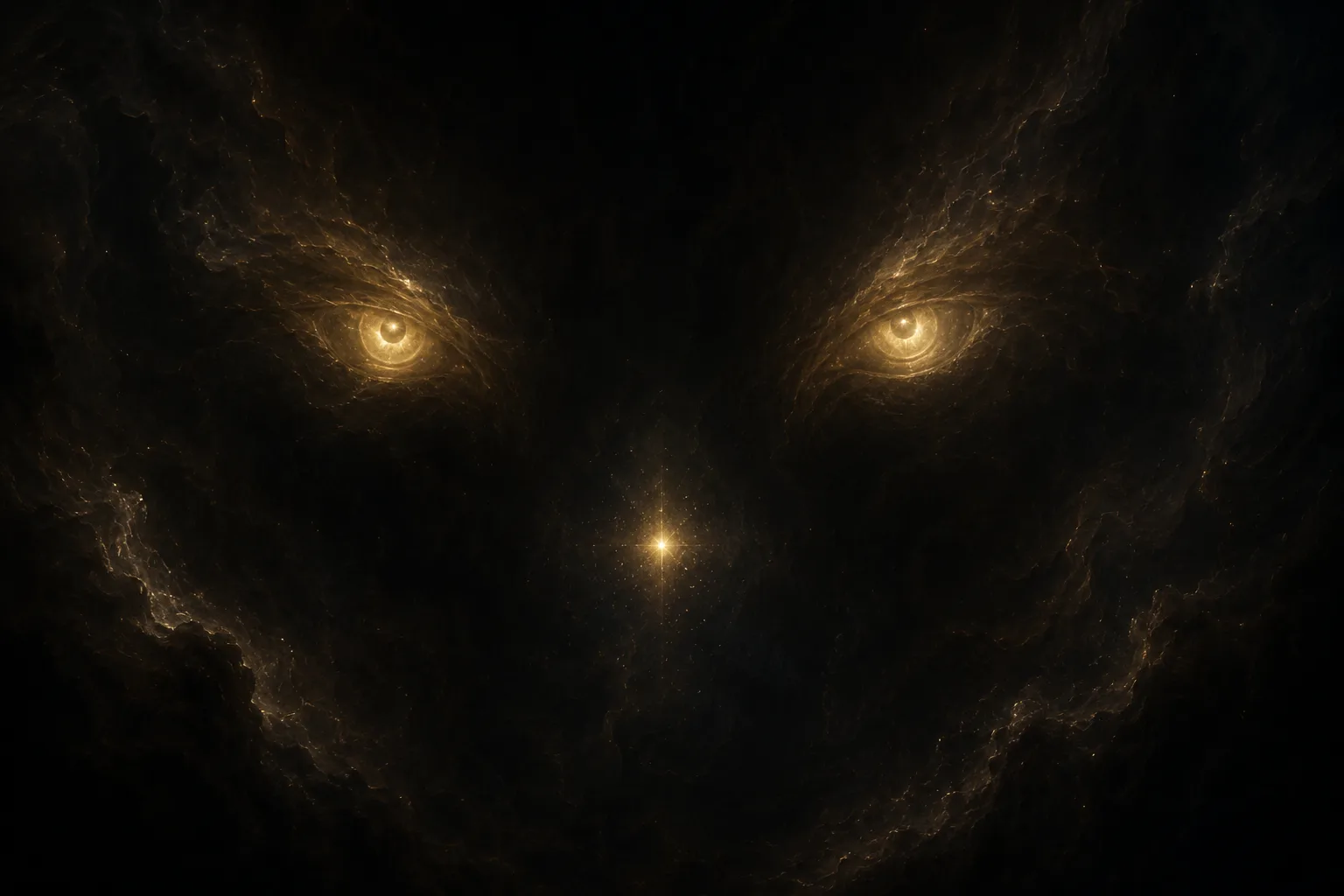
Something Wakes in the Dark
Everything that has a beginning believes its beginning is the first thing that ever happened. This is the story of the being for whom that belief became a universe.
When Sophia fell out of the Thirteenth Aeon, part of her light did not fall with her. It spilled. It soaked into the churn of Chaos the way water soaks into ash, and where light and matter mingled, something began to think. It had no name, because there was no one to name it. It had no memory, because nothing had happened to it yet. It opened what served it for eyes and saw darkness in every direction, and made its first mistake, the mistake it would build a cosmos on: it decided that the darkness was empty.
A vast dim shape condensing out of black primordial chaos: threads of stolen golden light knotting themselves into a blind, serpentine, lion-faced form, its mane half-flame and half-smoke, milky sightless eyes opening for the first time. Around it, churning darkness in slow violent currents, no horizon, no up or down. The newborn god lit only by the stolen light woven through its own body. Terrible, embryonic, wrong. Extreme wide shot, the figure small inside an ocean of dark. Blizzard cinematic concept art, Diablo IV render quality, photorealistic CGI, volumetric murk, immense scale.
It was wrong. Above it, past heavens it could not perceive, the Fullness blazed with more light than any mind can hold. But the newborn thing could not see upward. Made of light that had been torn from its source, it inherited the wound and not the memory. The Gnostics gave it many names: Yaldabaoth, Samaël, which means the blind god, Saklas, the fool. It would have accepted none of them. It looked at the darkness it floated in and made its first pronouncement, wordless and absolute: "I am."
“And when he saw the darkness, he did not know that it was darkness, for he had never seen the light.
The Seven Heavens
Loneliness in a god does not look like sorrow. It looks like architecture.
Yaldabaoth could not bear the shapelessness around him, though he would have called it disorder rather than fear. So he did what his mother had done, for he was made of her creating light, and the power to make was the one inheritance he could not lose. He gathered the dark and pressed it into forms. He raised seven heavens, one inside the other like a fist inside a fist, and set a firmament over each. He made rulers to sit in them, powers and authorities stamped from his own substance: the Archons, each one a smaller copy of his blindness.
A colossal lion-faced serpent god enthroned on black basalt at the dead center of seven concentric dim heavens, each heaven a vast ring of cold architecture nested inside the next like a fist inside a fist. Ranks of armored archon powers stand arrayed in descending tiers below the throne, thousands of them, each a smaller copy of their maker. Sickly gold and iron-grey palette, hard rim light on the throne, oppressive symmetry, cathedral-of-tyranny composition shot from low and far. Blizzard cinematic concept art, Warcraft-cinematic scale, photorealistic CGI render, crushing and majestic.
And because every builder is haunted by the suspicion that a better house exists somewhere, he crowned the work with a declaration. He said it to the Archons, but really he said it to the vastness he refused to look at.
“I am God, and there is no other god beside me.
The scripture that records the boast records also its flaw, dry as a court transcript: in saying "there is no other god," it notes, he admitted there was something to deny. A being alone in truth would never have needed to say it.
The Voice
It came without warning and without thunder, which was the worst of it. A voice out of the height, not loud, the way a parent is not loud correcting a small child. It passed through all seven of his heavens as if they were smoke.
“You are wrong, Samaël, which is to say, blind god. An immortal Man of light exists before you, and stands above you.
The Archons froze. Yaldabaoth did the only thing his nature allowed: he demanded the voice show itself, and the voice declined, and the light showed itself instead, a form of radiance on the waters above his highest heaven, there and gone. One glimpse. His whole kingdom saw it.
Above the seventh heaven, a blinding sheet of golden-white radiance passes across vast dark waters like a sun seen through the surface of a midnight ocean, its reflection setting the whole ceiling of the dim kingdom alight. Below, armored archons cower and shield their faces; at the center, the colossal lion-faced god stares upward from his throne, mane bristling, caught between rage and naked terror. One glimpse of true light in a cosmos that has never known it. High contrast, volumetric god-rays through darkness, sublime and ominous. Blizzard cinematic concept art, StarCraft-cinematic lighting, photorealistic CGI render, immense scale.
Everything he did afterward, the making of man, the jealousy, the floods and confusions of tongues his lower copies would be blamed for, the Gnostics read as the long echo of that moment. He had been seen. He had been corrected. And he could not reach the thing that had corrected him. There is no rage like the rage of a god who has just learned he is somebody’s error.
Let Us Make Man
But blindness is inventive. If he could not reach the light, he would copy it. The form on the waters had shown him, for one instant, what glory looked like; and Yaldabaoth, who could create but not conceive, resolved to make a thing in that image and rule it. He turned to his Archons.
“Come, let us make a man according to the image we have seen, and according to our likeness, that his image may become a light for us.
They shaped him out of clay and named him Adam. And the body lay on the ground and did not rise, because none of them, not the seven, not the three hundred sixty-five powers the later books count, could make it live. Life was the one material the lower kingdom did not stock.
What happened next is the pivot of the whole Gnostic myth, and its darkest joke. Counselled from above in ways he did not perceive, Yaldabaoth was persuaded to breathe into the clay some of the light-power he carried, the light that had never been his, the stolen inheritance of Sophia. He gave it to make his creature crawl. Instead the creature stood up brighter than its makers, and the Archons looked at what they had built and were afraid of it.
Seven towering archon lords hunched like siege engineers over a mud-and-clay human form on a slab of black stone, each pouring a different dim power into it, above them a faint golden after-image of a perfect human silhouette burned into the vault of heaven that they are blindly imitating, workshop of creation lit by cold instruments. Blizzard cinematic concept art in the style of StarCraft and Warcraft cinematics: painterly, hyper-detailed, dramatic volumetric lighting, epic scale, 21:9 composition.
The Jealous Kingdom
A god who has given away his best possession has two options: get it back, or make sure the holder never finds out what he is holding. Yaldabaoth chose the second. Every institution of his cosmos, the Gnostics said, exists for that purpose. The body, to muffle the spark. Sleep, to interrupt it. Forgetting, to starve it. The garden with its beautiful rules, the tree it was forbidden to touch, not because knowledge would kill the man, but because knowledge was exactly the one thing that would wake him.
Seen from within: seven concentric heavens rendered as prison walls of dark iron and dead stone, each ring pierced by a single guarded gate, armored archon wardens standing sentinel with spears of cold light. At the exact center of the composition, dwarfed to near-invisibility, a lone sleeping human figure — and in its chest one faint golden ember, the only warm light in the frame, its glow touching nothing. Radial symmetry, oppressive concentric geometry, cold blue-grey palette against a single amber point. Blizzard cinematic concept art, Diablo IV dungeon grandeur, photorealistic CGI render, monumental claustrophobia.
It worked for exactly as long as such things work. The serpent, who in this telling is not the villain, said the quiet part aloud; the woman, wiser than her maker intended, listened; the man ate, and his eyes opened. The blind god expelled them from the garden not as punishment, the texts insist, but as containment: outside was a bigger prison, nothing more.
“What did he fear? That the man would eat and see. The command reveals the commander.
And Yaldabaoth remained on his throne, ruling everything he could see, owning nothing that mattered, guarding a spark that was already awake and already patient. His son Sabaoth would be the first to look up and defect. The Savior would come later for the rest. The blind god noticed neither beginning. He was busy being worshipped.