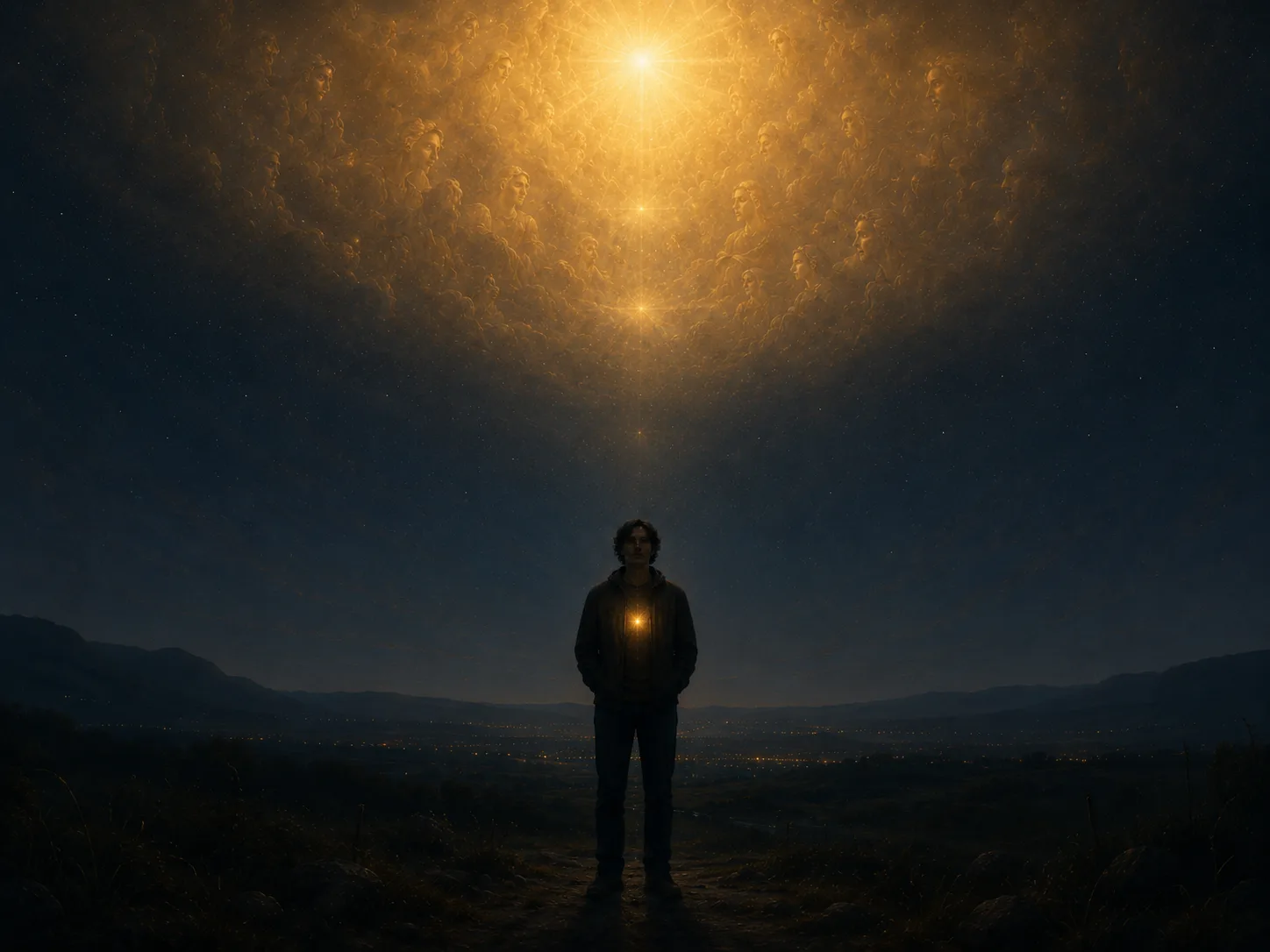
A Trap Shaped Like a Man
Man was not made in love. That is the first of this story’s inversions, and the gentler ones follow from it. When the powers of the lower world glimpsed the true Light on the waters above their heaven, they conceived the only response blindness allows: imitation. "Come," said the blind god to his Archons, "let us make a man according to the image we have seen." Part flattery, part theft, part trap — for a thing shaped like the light, they reasoned, might lure the light down where they could hold it.
So they shaped him: three hundred sixty-five powers, the later books say, each contributing a joint, a humor, an organ, until a complete body lay on the ground like an unlit lamp. They named it Adam, from the red earth it was pressed from. And then came the difficulty that undoes every counterfeiter: the original moves, and the copy did not. The body lay there. Nothing in the seven heavens could make it live.
The Breath
What happened next, the Gnostics tell with open glee. Counsel came to Yaldabaoth — whispered from above, through channels his blindness could not audit — that the body would stand if he breathed into its face some of the power he carried. And the blind god, eager to see his trophy work, did it. He bent over the clay and exhaled the light of Sophia — the stolen radiance that was the only treasure his kingdom had ever held — into the sleeping face of a man.
“He breathed into his face, and the power of his mother went out of him into the body; and he did not know it, for he existed in ignorance.
The body stood up luminous. And the Archons, who had built a servant, found themselves squinting at it. The thing outshone them. It thought faster than its wardens; it named what they could not; the light in it answered to none of their offices. In a single breath the blind god had transferred the divine inheritance out of his own keeping and locked it inside his prisoner — which means, the texts note with satisfaction, that from that day the most valuable thing in the material cosmos has been man.
The Archons did what fear always does with what it cannot match: they buried it. They wrapped the luminous one in dense matter, dimmed him into flesh that tires and forgets, and set him in a walled garden — a beautiful enclosure with one rule, which is the definition of a trap.
The Tree and the Serpent
Every warden’s regime produces one law that gives the whole game away. In the garden it was the tree. Not a tree of poison, not a tree of death — a tree of knowing. Of all the things growing in the enclosure, the single thing forbidden to the luminous prisoner was the fruit that would let him see. The command, as the Gnostics read it, is a confession: the gardener feared nothing in the world except his prisoner’s eyes opening.
“What did the maker fear? Not that the man would die, but that he would eat, and see, and become as one who knows.
And so this telling performs its most famous inversion. The serpent — cursed in the canonical account, crushed under heels for two thousand years of iconography — appears here as the first teacher. Some texts say the true Wisdom spoke through it; others that it was an instructor sent down on purpose. Its message, stripped of scales, is one sentence: they lied to you about what the fruit does.
The woman listened first — in these books she is consistently the quicker of the two, the one the light leans toward — and ate, and gave to the man, and their eyes opened. What they saw first was not sin. The texts are specific: they saw their makers. They perceived, behind the voice in the garden, the shape of the Archons — and knew, with the first knowledge, that the gardener was not God.
The Expulsion
The rest happened quickly, as reprisals do. The wardens fell on the garden, cursed the serpent, cursed the ground, and drove the two luminous prisoners out through the east gate into the wide world — pronouncing it a punishment, though the Gnostics read the sentence differently: the garden had failed as a containment, so the containment was enlarged. Toil, pain, and death were issued not as justice but as sedation, a regimen to keep the waking spark too tired and too brief to organize.
It did not entirely work. It has never entirely worked. The knowledge passed from the first pair into their children like an heirloom smuggled through a checkpoint — flaring up in one generation as prophecy, in another as philosophy, in another as the simple unaccountable certainty, arriving at three in the morning, that this world is not the whole story and was not always your home.
“The light is in them, and they do not know it; and this not-knowing is the whole kingdom of the rulers.
That is why the sleeper in clay is the hinge of the entire mythology. Sophia fell; the Savior descended; but the spark they fell and descended for is carried by the reader. The oldest story in the world, read this way, has no ending yet. It is waiting on you to wake up.